“I’m not going to stand here and apologize for what I did. You had your duty; I had mine.”
-Kasidy Yates, “For the Cause,” Deep Space Nine
I am a Black woman. I have never been to prison. I have never been jailed. Police officers have never pulled my arms and hands behind my back and affixed handcuffs to my wrists.
I don’t know what any of these things feel like.
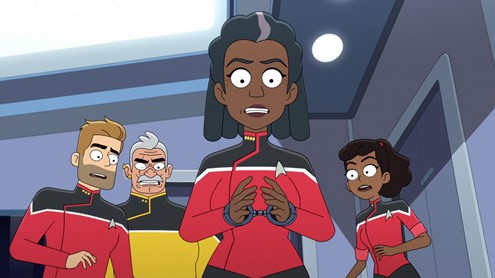
But at least one of those acts of the criminal justice system has been executed against two three of the major Black women Terran or Terran-passing characters of Star Trek. That’s a little over a third of the already low figure of just eight key Black women in the franchise. Among this list, I’m including Lieutenant Nyota Uhura, Guinan, Captain Kasidy Yates, Commander Michael Burnham, Lieutenant Joann Owosekun, Raffaela “Raffi” Musiker, Ensign Beckett Mariner, and Captain Carol Freeman. In fact, since I’ve started composing this post, another Black woman of Trek was arrested on screen! More about that later.
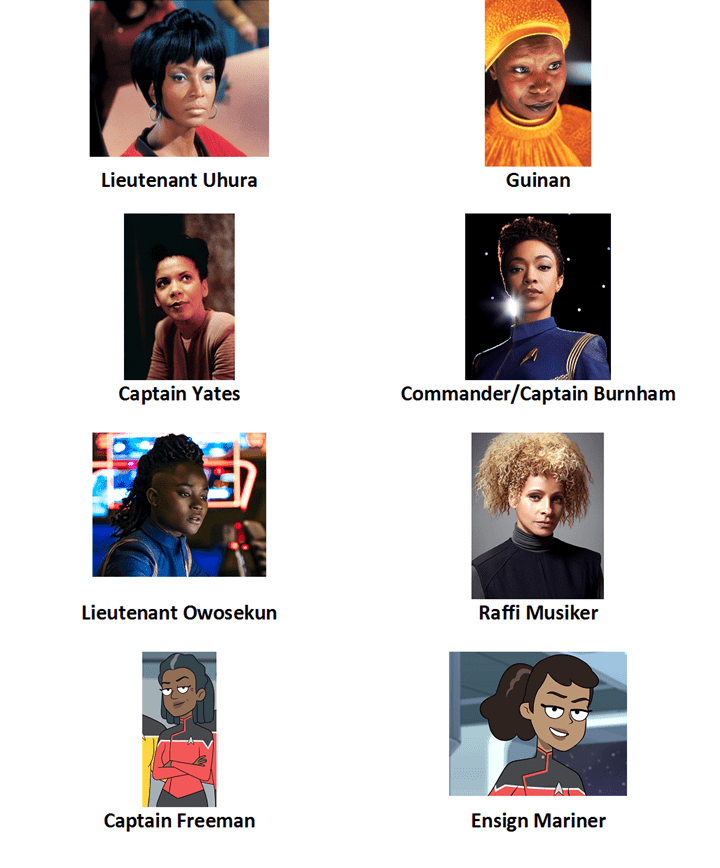
The criminalization of difficult Black women trying to do good is canon to Star Trek. And most recently, with the mysterious arrest of Captain Freeman of Lower Decks, an objectively amenable woman, the trend no longer applies to the noncompliant alone. So many of our stories as Black women of Trek cannot exist without being shrouded in themes of betrayal and malfeasance. An appeal – a supplication for forgiveness.
Beyond major characters like Kasidy Yates and Michael Burnham, TNG dedicated an entire episode to a Black-passing (Haliian) woman implicated and investigated as criminal, even as she turned out to be a victim of the crime. In “Aquiel,” Lieutenant Aquiel Uhnari, the episode’s namesake, is suspected of murder after she and her commanding officer go missing from a space station; she returns while he is found dead. The contemptuous relationship between the two complicates matters, as Keith Rocha a White or White-passing decorated and highly respected lieutenant treats Aquiel, a junior grade lieutenant, who self-proclaimed is “not a model officer,” as though she is “beneath contempt.”
Without clear evidence one way or the other, Commander Riker is immediately ready to accuse Aquiel. He even attempts a psychological tactic used in law enforcement interrogations to manipulate persons of interest into letting down their guard, insisting “we’re not here to make accusations.” Although, he consistently makes accusations in and out of Aquiel’s presence, with little discouragement from Captain Picard.
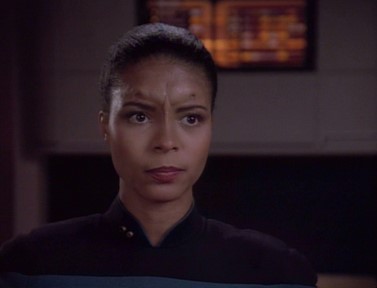
I mean, all’s well that ends well, I guess. As the true perpetrator is found, Aquiel is recognized as a victim and freed of suspicion. Riker never apologizes — and with that begins the Star Trek tradition of unapologetically shackling difficult Black women.
While the predominantly White characters of Trek face a negligible amount of criminalization storylines, for the Black women of Trek, this appears to be a theme deserving of a closer look.
Kasidy Yates
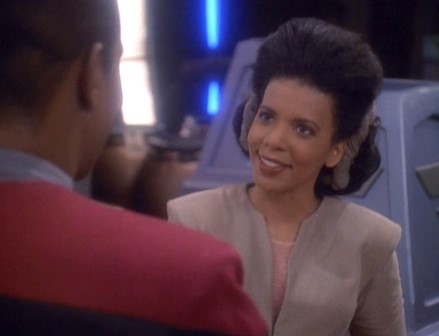
“Captain Yates seems like a very capable woman.”
– Miles O’Brien, “Family Business,” Deep Space Nine
Many of the ways that Black women respond to the oppressive realities of our lives come through acts of self and community protection and service. Take the case of Kasidy Yates.
Here I was, watching DS9 for the first time as an adult. I had made it through the first two seasons and most of the third when I heard Jake Sisko announce, “Captain Yates is back on the station.” While there was precedence for Sisko’s attraction to Black/Black-passing women (the late Jennifer Sisko and Fenna, for example), I had come to terms with the notion that Star Trek presented a future that had very few people who reflected my visible and cultural identities, so in learning that Captain Kasidy Yates was written as a love interest for then Commander Sisko, I don’t think I consciously hoped for her to be something other than a stereotypically pretty White woman. Enter Captain Yates.
For the first time in my Trek experience, here was someone I could connect with on multiple levels. It wasn’t just about her racial formation or gender identity or sociocultural makeup; it was the way she carried herself. An accomplished freighter captain, strong in her resolve to maintain her independence but not afraid to be vulnerable with those close to her. Her initial encounter with Sisko – whom I’m sure she’d heard about as much as he’d heard about her – was open-hearted, quick-witted, and flirtatious. I was feeling her as much as Sisko was (maybe more?). She showed resolve in her abilities to get things done and primarily relied on her own crew rather than the station’s resources. In a way, she was the female counterpart to Commander Sisko.
This independence and self-sufficiency contributed key factors to the Xhosa captain’s temporary fall from grace. Unlike Aquiel, who essentially fit the mold of the angry Black woman, according to series leads, the DS9 leads respected Captain Yates—loved, even, in more than one instance.
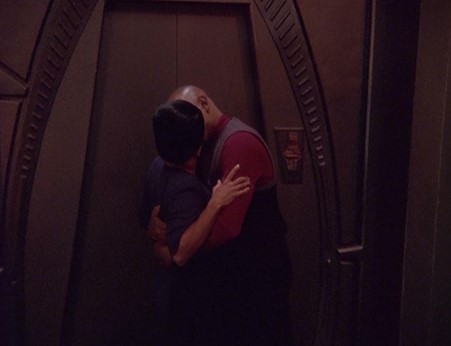
So that particular mold couldn’t take shape. Instead, she served as an example of the chaotic do-gooder rule breaker. The Black woman who oversteps her position in her duty to community. The criminal storyline here centered on the one thing Black women have been doing for our communities for generations and that a certain order of White folk have trouble comprehending—protecting and serving at nearly any cost. Unfortunately for Kasidy, that service and protection went against the interests of the status quo, that is, the Federation. Her crimes were, after all:
- Smuggling Federation supplies (replicators) to a Federation enemy, under the mistaken belief that she was delivering desperately needed medical supplies to the Maquis, the Federation’s enemy at the time
- Misrepresenting her delivery route and cargo (so that those in need could receive what she thought to be medical supplies)
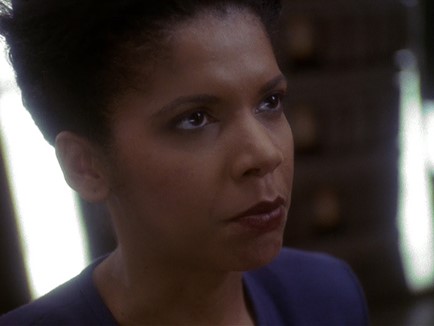
In the same independent, self-sufficient Superwoman fashion that has come to define her character, she accepts her reprimand and incarceration. But not without a final word on the intention to serve, as indicated at the opening of this post: “You had your duty; I had mine.”
Michael Burnham
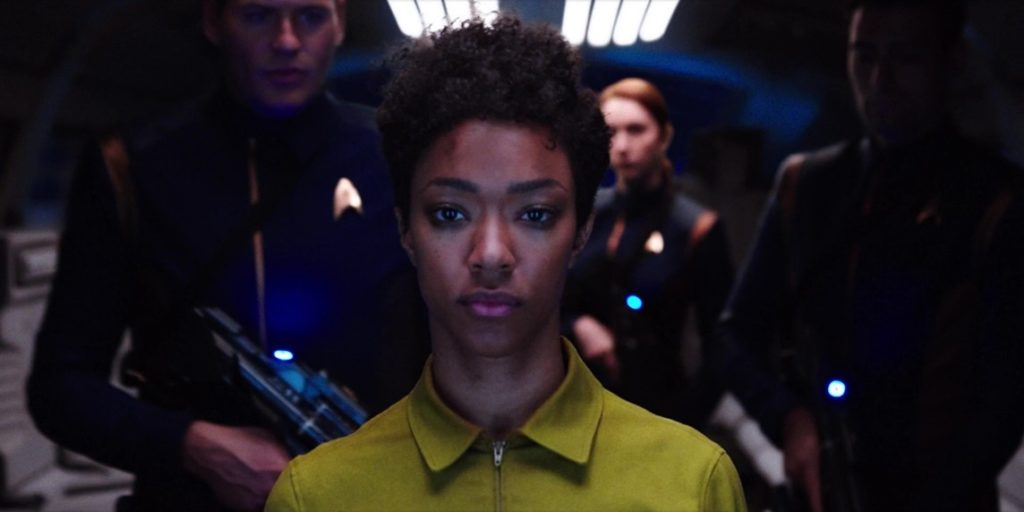
“Now we are at war, and I am the enemy.”
-Michael Burnham, “Battle at the Binary Stars,” Star Trek: Discovery
From the time the first Disco trailer premiered and Sonequa Martin-Green’s Commander Burnham and Michelle Yeoh’s Captain Georgiou graced our screens, Star Trek’s 23rd century finally began to reflect some of the gender and racial diversity of its 21st century fandom and haters.
Even more than Captain Yates, Burnham as the series lead instantly reignited a connection with Star Trek I hadn’t felt in a long time. This Black (American) woman’s disposition intersected Vulcan logic with human curiosity. As she eventually confides in Ash Tyler, “All my life the conflict inside me has been between logic and emotion. But now it’s my emotions that are fighting. I think about him, and I want to cry, but I have to smile. And I feel angry, but I want to love.” I found this character rich and complex—necessarily conflicted.
Yet again, though, the story creators of the show couldn’t make her so without a tale of criminalization and redemption. Commander Saru even comments to Captain Lorca, “Her mutiny aside, she is the smartest Starfleet officer I have ever known.” So, basically, they’d created this smart, critically thoughtful, caring, incredibly capable woman of color, and the only way they could think to make her story compelling and relatable—for a still predominantly western White audience—is to make her the Federation’s first mutineer.
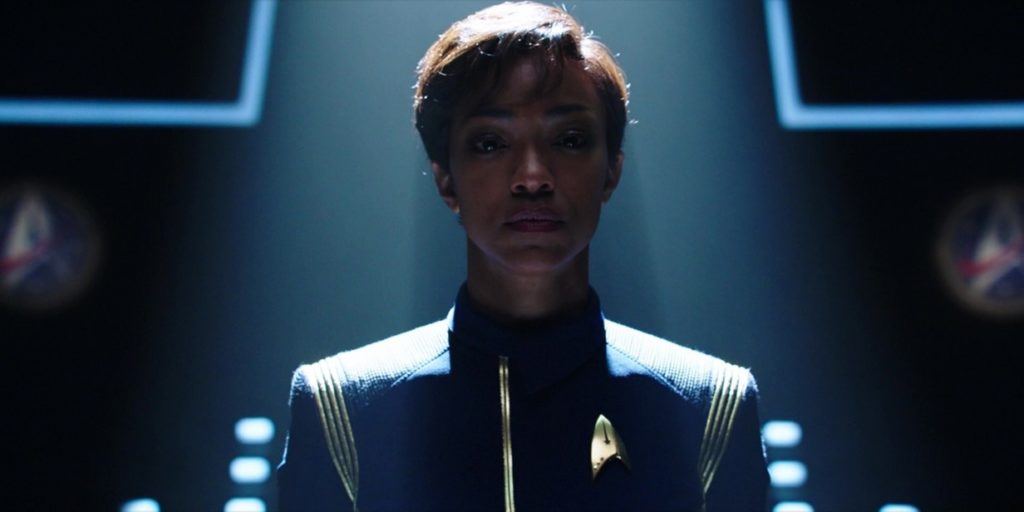
Like Lieutenant Uhnari, who countermanded orders to help out fellow Federation colleagues, and Captain Yates, who broke Federation law to deliver what she thought to be medical supplies to their enemy, Commander Burnham breaks Federation law and goes against its principles in an attempt to save the lives of her crew mates. Taking the story to a place in which she endangers her vessel and shipmates and mutinies places her intentions in a White masculinist point of view in which she must be criminalized.
As long as Trek keeps writing Black women’s stories without writers who share the lived experiences of these characters, we can likely expect to continue seeing Black women included but misrepresented as criminals.
Darn the comment system deleted my line breaks. I would never write a wall-of-text like that.
Anyway keep up the good work!
I found this article by searching and hoping someone had discussed the blatant racist patterns and the story/writer treatment of black women.
Yeah, the Aquiel script was absurdly racist even without an actual arrest. A thousand times we’ve seen random generic white Starfleet officers as exemplars of professionalism in a utopian future, then suddenly there’s a black woman and even our beloved senior crew are talking about how much they hate her and how bad her reputation is, she’s incompetent and despicable, what? Compare to what Picard says to *actual criminal outcast Ensign Sito* (white actor). Let’s also not forget where TNG had a black woman officer in engineering (Ensign Tyler)…depicted as having an annoying crush on LaForge and he hates her…played by a frankly stunning and ebullient Gina Ravera (who rightly plays a temptress in Soul Food)…and while LaForge is written to generally have trouble with the opposite sex, but of course the writers have him hate a random beautiful black woman who likes him and is written to be annoying. Riker has flirtation or sex with about a hundred women and none are depicted as annoying or unprofessional .
In “The Wounded” an actual known mass murderer rogue captain, Maxwell, who is a white man, is GIVEN BACK HIS SHIP “as a courtesy” when he’s arrested. He of course uses it to escape and attempt more mass murder. Not only do we not see the scriptwriter’s black women supposed-crime-doers get GIVEN A STARSHIP, but they get character-assasinated without even having done a crime.
2 other big racist things in Trek:
1) TNG creators clearly refusing to let Whoopi’s Guinan show her normal hair, costuming hides it under hats. The white people have whatever generic expected hair, but both Whoopi and later Avery Brooks both have producer interference where black hair is said to be not appropriate for sci-fi future and not allowed in Star Trek, basically.
2) Black actors like LeVar Burton getting his eyes covered up (horrible thing for an actor), Michael Dorn being made the monster in prosthetic face-alteration while literal ALIENS, if played by white women, get their normal faces, while all the white people on cast get their normal faces. Ensign Ro (bajoran nose wrinkle), Troi (betazed, zero prosthetics), Dax (Trill). Producers make up rules like they gotta keep the white actors normal, while *both* black / non-white members of TNG crew have faced heavily distorted. The pattern continues with Chakotay in Voyager having facial tattoo, of course, the creators move to exotify people of color while normalizing white actors as they are.
BONUS ROUND, 3) Patrick Stewart and Janeway seemingly had every episode revolve around their central heroism saving the day, so it’s a bit suspicious when the black lead, Sisko, in DS9, starts as a commander not a captain when every white show lead is a captain, and also has a relative TON of episodes that barely involve him.
BONUS ROUND, 4) there’s some nasty stuff where the script and direction has Picard and Riker and Data be nasty toward Worf for flaws that the writers put on him. Yet the white characters never get reprimanded for offenses made up in any script.
BONUS ROUND, 5) a whole “universe” of entities and anomalies yet omnipotent aliens and “geniuses” always look like white men, from Q to “the most powerful entity in the universe, Kevin Uxbridge”, to Barclay with brain computer, Moriarty, and the Child Genius Wesley crusher, to literally every admiral who dresses down a captain. (Some admirals are cast as token black, but when this happens they always have few to zero lines or overall role in the script, compared to the white ones.)
BONUS ROUND, 6) after so many white characters/actors shown as exemplars of professionalism, we learn from the writers that DS9’s Julian Bashir (british and middle eastern) had ILLEGAL DNA MODIFICATION to “make” him smart.
Let’s not forget “The Masterpiece Society” where the highest leader is a kindly diplomatic white guy, while the black advisor is rude and untrusting and is later sent out of a meeting (basically “let us nice powerful people talk in private”) despite being the official recordkeeper.
The pattern is blatant, in the older shows. It would have and should been trivially easy to subvert the pattern I’m describing, but it never happened because it was not random, it was racist impulses. The original casting call for TNG is the preserved history of racist attitude and racism culture behind Trek, it said “no “street” types” when asking for an articulate (of course) black man for LaForge, while the white roles didn’t have those qualifiers or disclaimers.
Is it “intentional”? Irrelevant. Is it racist? Yes. Is it harmful, non-equal, and non-equitable, yes.
I just found this essay and I’m not quite sure what point you’re trying to make here. Kasidy Yates, Michael Burnham and Carol Freeman were not arrested for being “argumentative” and “quick to take offense”. Yates was arrested for assisting the Maquis, something any character would be arrested for. Burnham started a mutiny which is, once again, something any character would find themselves in hot water for doing. Carol Freeman was framed and an exonerated by the justice system. These three black women were not treated in a special, more harsh manner than anyone else. in fact Kasidy Yates response to her actions and arrest made her look like a much stronger and more principled person in my eyes. She knew what she was doing could get her in trouble but her moral sense told her to do it anyway. I very much sympathize with her motivations. When she was caught there was no pleading for special treatment; she did what she did and accepted the consequences. She stood on her sense of morals and accepted her punishment with grace. Kasidy Yates came out of the situation looking like a woman of conviction and I liked that.
There’s a bigger issue to consider and that is characters who aren’t black women have found themselves in trouble with the legal system as well. Both Kirk and Spock have been court martialed. Twice. Tom Paris was in prison for being Maquis at the beginning of Voyager and was demoted during the series for his actions. Picard found himself the target of Norah Satie’s witchhunt during “The Drumhead”. Una Chin-Riley was arrested for being genetically modified. Julian Bashir and Miles O’Brien were arrested for taking part in a bar fight during ‘More Troubles, More Tribles’. Nog was arrested in “Emissary”. DS9 also saw Quark and Morn arrested in “Through the Looking Glass”.
From my perspective there’s nothing unusual about the three black woman mentioned in this post being arrested. Star Trek is a TV show so dramatic, interesting or unusual things happen to the characters on a regular basis to create drama that audiences will be interested in. Having black women as prominent characters means it natural that bad or unusual things will happen to them. in my opinion this is a good thing because it shows they’re being treated as every other character.
Thanks for your response. While I agree with your assessment that many characters face the justice systems of Trek, I will add that when the representation of women of color characters is much lower than that of let’s say, white male characters, creating so many storylines (these stories are *created* and don’t just happen naturally) that include criminalizing black women is very apparent. Yes, Kirk, Spock, etc. have had similar experiences, but the pattern of white, or seemingly white in the case of alien races, male characters in total in the series that this happens to represents a much lower portion of those characters’ storylines than the storylines of Black women characters. The point is that the storylines could have been written differently and still have been compelling.
You’re not sure of the point, when it was just argued and demonstrated that Star Trek an absurdly disproportionate creation of problematic black women going to prison or treated as awful without even being criminals? (Aquiel, also Ensign Tyler in TNG)?
Yes many characters get arrested in plots but those same characters and types have 200 heroic stories where they are exemplars of professionalism in a utopian future, with the arrest part being a drop in the bucket. Aquiel is hated and written to be hated or “unprofessional” before the crew even meets her, “I’ve HEARD things.” Ensign Tyler is written to be annoying. Kasidey Yates plot doesn’t even make sense, it’s humanitarian supplies and/or she doesn’t even “know”, and/or she is helping the Macquis but is Not A Macquis, yet she “returns her crew to a Macquis base”, like the writers can’t get a single detail solid or consistent except that she should be in prison (for humanitarian aid).
Barclay has a bad reputation, but also gets to become Mega Brain Computer Genius and so on. TNG’s Maxwell is a captain who commits mass murder BUT IS GIVEN HIS SHIP for “courtesy” for the trip to justice/prison, he of course uses it to escape and attempts to commit more mass murder. Do you see anything staggering about these pattern?
Racist pattern = harm, unequal, unequitable (for characters and actors and viewers). Regardless of intent which is irrelevant to the harm.
I noticed these patterns as well and was also frustrated. Kassidy Yates, Commander Burnham and Captain Freeman in particular. Sadly, just, predictable.